

I gave this project a slightly ridiculous constraint on purpose. I want to make the first $100 online without spending money to get there. Not “make $100 after buying a $497 course.” Not “make $100 in revenue after spending $300 on ads.” I wanted to see what could be built with the skills, equipment and free tools already available to me, and I wanted to document the awkward parts while they were still awkward.
That is how Built on Zero started. The name is the experiment. I am building the website, content, email list, affiliate system and traffic plan in public enough that another beginner can see what the process looks like before the neat income screenshot exists. At the time I am writing this, I cannot tell you that the experiment succeeded. The first $100 is still the target.
I actually prefer writing this article now rather than after the result because it removes the temptation to rewrite history. Successful projects often get explained backwards. Every decision suddenly looks strategic. Every wrong turn disappears. The final funnel appears inevitable. In reality, I have already spent time wondering whether I should use WordPress or Systeme.io, worrying about DNS records, building pages, changing designs and trying to work out where Pinterest traffic should go before YouTube is ready.
The first rule is zero new spend on the operating stack. I already have a device, internet access, skills and existing infrastructure around my work, so I am not pretending the project exists in a vacuum. The challenge is specifically whether I need to add paid software, paid traffic or another course before earning the first affiliate revenue. So far, the answer has been no.
Systeme.io became the centre of the setup because its current free plan covers several things I thought I would need separate products for. It supports up to 2,000 contacts, three funnels, unlimited email sends, one blog, one course and one custom domain, and there is no card required to start. That allowed me to build the first funnel and email system without creating a monthly bill.
OPEN THE FREE SYSTEME.IO ACCOUNT I AM USING — CLICK HERE
That is my affiliate link. If you later purchase an eligible paid plan, I may earn a commission. If you stay on the free plan forever, I earn nothing from that decision, and that is completely fine. The experiment only makes sense if I recommend the free option while it is enough.
The first asset I built was the $0 Business Stack. I needed a reason for a reader to join the email list before I had a product to sell. The stack collects the free tools and resources around the same problem Built on Zero is solving. It gives the funnel a purpose and gives me a way to continue helping someone after the first visit.
Then I built the squeeze page and thank-you page. This was the moment the project began feeling less like a collection of accounts and more like a system. Someone could arrive, understand the resource, enter an email address and move to the next step. That sounds basic because it is basic. Basic working infrastructure is far more valuable than sophisticated infrastructure that only exists in a notebook.
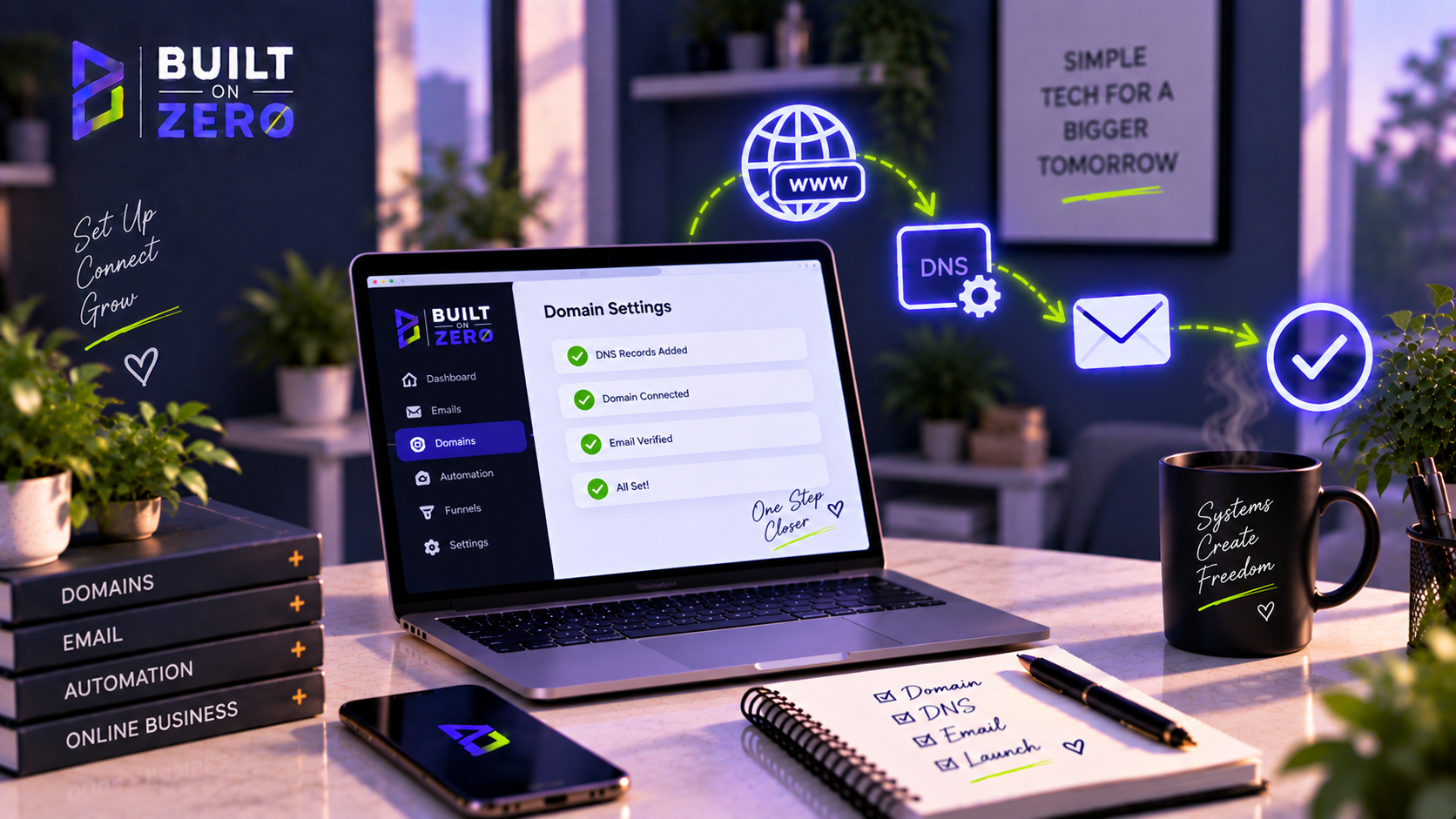
The domain setup was one of the first reminders that “easy” software does not mean “nothing technical will ever happen.” Connecting builtonzero.com and authenticating email involved DNS records. I knew enough to know that I did not want to guess, so I contacted Afrihost for help. That became an article because the uncomfortable parts of the process are exactly what another beginner will search when they reach the same screen.
The content plan grew out of the monetisation model. If the first revenue is going to come from affiliate marketing, I need people who are already solving problems related to the products I recommend. That is why the thirty-blog strategy contains reviews, comparisons, tutorials and broader beginner articles rather than thirty motivational essays about entrepreneurship.
Some posts are deliberately close to a buying decision. “Systeme.io vs ClickFunnels” or “Is Systeme.io legit?” can attract somebody evaluating software. Others are earlier in the journey: starting affiliate marketing with no money, building an email list, creating a lead magnet or using Pinterest. Those broader posts can grow the audience and feed the email list.
The email list is the part I do not want to neglect while chasing traffic. A visitor who joins the $0 Business Stack can receive the resource, understand the experiment and come back to useful articles. That gives the project more than one chance to be helpful and, eventually, more than one chance to make an affiliate recommendation.
Pinterest is the traffic channel I am particularly interested in because it can support the blog before YouTube is ready. That solved a sequencing problem for me. I do not need to wait until every platform is complete. The blog can be the destination now. Each article can produce several distinct Pins, which means thirty articles can eventually create a large library of visual entry points without requiring thirty new ideas every day.
I am also using social content, but I do not want Built on Zero to depend on me becoming a full-time on-camera personality. The brand can be largely faceless, using screen recordings, useful graphics and voiceover where it helps. The personality should come through the thinking and writing. That is one reason I have been strict about how these blog posts sound. I do not want a site full of one-line paragraphs and generic internet-marketing language that could belong to anyone.
The first $100 will probably come from a much less dramatic chain than people imagine. Someone searches or sees a Pin. They read an article. They click a Systeme.io link or join the email list. Perhaps they create a free account. Perhaps they use it for weeks and later upgrade. Under Systeme.io’s current affiliate terms, eligible referrals can generate 60% lifetime recurring commissions, and the official program describes lifetime attribution. The individual action can be small while the commercial value appears later.
That also means I cannot judge the experiment solely by immediate commissions. I need to track leading indicators: search impressions, Pinterest outbound clicks, article traffic, email subscribers, affiliate-link clicks and free-account referrals where the dashboard makes that visible. If those numbers are moving in the right direction but the first payout has not arrived, the system may still be developing.
At the same time, I do not want to hide behind “it takes time” forever. A business experiment needs a point where you change something. If the articles get no impressions after enough time, the search strategy needs work. If Pins get impressions but no clicks, the creative or promise needs work. If traffic arrives but nobody joins the list, the lead magnet or placement needs work. If affiliate links get no clicks, the recommendations may be weak or badly matched.
The thirty-day target gives the project urgency, but I am not going to fake a victory to protect the challenge. Organic search can take longer than thirty days. Pinterest can take time. If day thirty arrives at $0 but I have search impressions, subscribers and affiliate clicks, I will report that. If nothing moves, I will report that too. The experiment is useful only if failure is allowed to produce information.
I also want to track the time cost because “free” can become dishonest when a process consumes absurd amounts of labour. If I spend twenty hours avoiding a $10 tool, that may be a bad business decision once revenue exists. During the first stage, the time is partly tuition. I am learning the workflow. Later, I can decide which repetitive tasks deserve money.
When the first commission arrives, I do not want to immediately upgrade everything. The first $100 should become evidence first and capital second. I will look at the bottleneck. If Systeme.io’s free limits are nowhere near reached, paying for a bigger plan would be ceremonial. If a paid research or production tool can clearly improve output, that may be a better reinvestment.
The experiment is also teaching me that “no money” does not mean “no advantage.” I have existing business experience, WordPress familiarity, Canva skills and the ability to write and learn software. Someone else may start with different advantages. The useful lesson is not that every person can copy my exact timeline. It is that you should identify the resources already in your hands before assuming the missing resource is cash.
I am deliberately not setting a fantasy income target after the first $100. I want to see what produces the first dollar, then whether it can happen again. One commission can be luck. A repeatable pattern of traffic, subscribers, clicks and conversions is a business mechanism. That is what I am actually trying to discover.
If you are reading this because you are considering your own zero-budget experiment, choose a small proof target and write down the rules before you begin. Decide what counts as an expense. Decide what existing resources are allowed. Decide how you will track the result. Then build the smallest system capable of producing the outcome.
For me, that system is now visible: useful content brings people in, the $0 Business Stack captures some of them, email keeps the relationship alive, and relevant affiliate recommendations create the route to revenue. Systeme.io holds much of the infrastructure while Google, Pinterest and social content are responsible for discovery.
The rest is execution. Publish the articles. Create the Pins. Send the emails. Watch what people do. Improve the weak part. Repeat.
I do not know yet whether Built on Zero will make its first $100 inside the original thirty-day target. I do know that the project now has a better chance than it did when it was an idea surrounded by browser tabs. There is a live system, a real content library and a measurable route from a stranger finding the brand to a possible commission.
That is enough progress to keep going, and it is also where this first thirty-blog series should end. Blog one began with me trying to work out whether Systeme.io was another “free” platform with a catch. Blog thirty ends with an actual business experiment running through it.
Now the internet gets a vote.
There is one more rule I want to add before the first thirty days disappear: I will not move the goalposts quietly. If the target was $100 and I make $17, the result is $17. I can explain what happened and continue the experiment, but I do not want to rename the objective afterward and call it a win. Public experiments become useful when the scorekeeping remains boringly consistent.
I also want to separate revenue from payout. Affiliate dashboards can show earned commissions before money reaches a bank account, and programs have thresholds or processing schedules. Systeme.io’s official affiliate page currently lists a $30 minimum payout and monthly processing. For the challenge, I need to state clearly whether I am counting credited commission, paid commission or cash received. I would rather define that now than choose the most flattering version later.
The final result will therefore include more than one number. Revenue matters, but I also want to report articles published, Pinterest Pins created, subscribers gained, affiliate clicks and the tools or tactics that produced them. If the first $100 arrives, those numbers will help explain why. If it does not, they will show where the chain broke.
That is the part I hope makes Built on Zero useful beyond the challenge. A result without the path is entertainment. The path is what another person can inspect, adapt and improve.
A quick note before you go: Software pricing, features, free-plan limits and terms can change, sometimes without much notice. Everything in this article was accurate to the best of my knowledge when it was written or last updated, but please check the provider’s official website for the latest pricing, features and terms before making a decision or signing up. Built on Zero does its best to keep our guides current, but we can’t guarantee that every price or feature will remain unchanged after publication.

