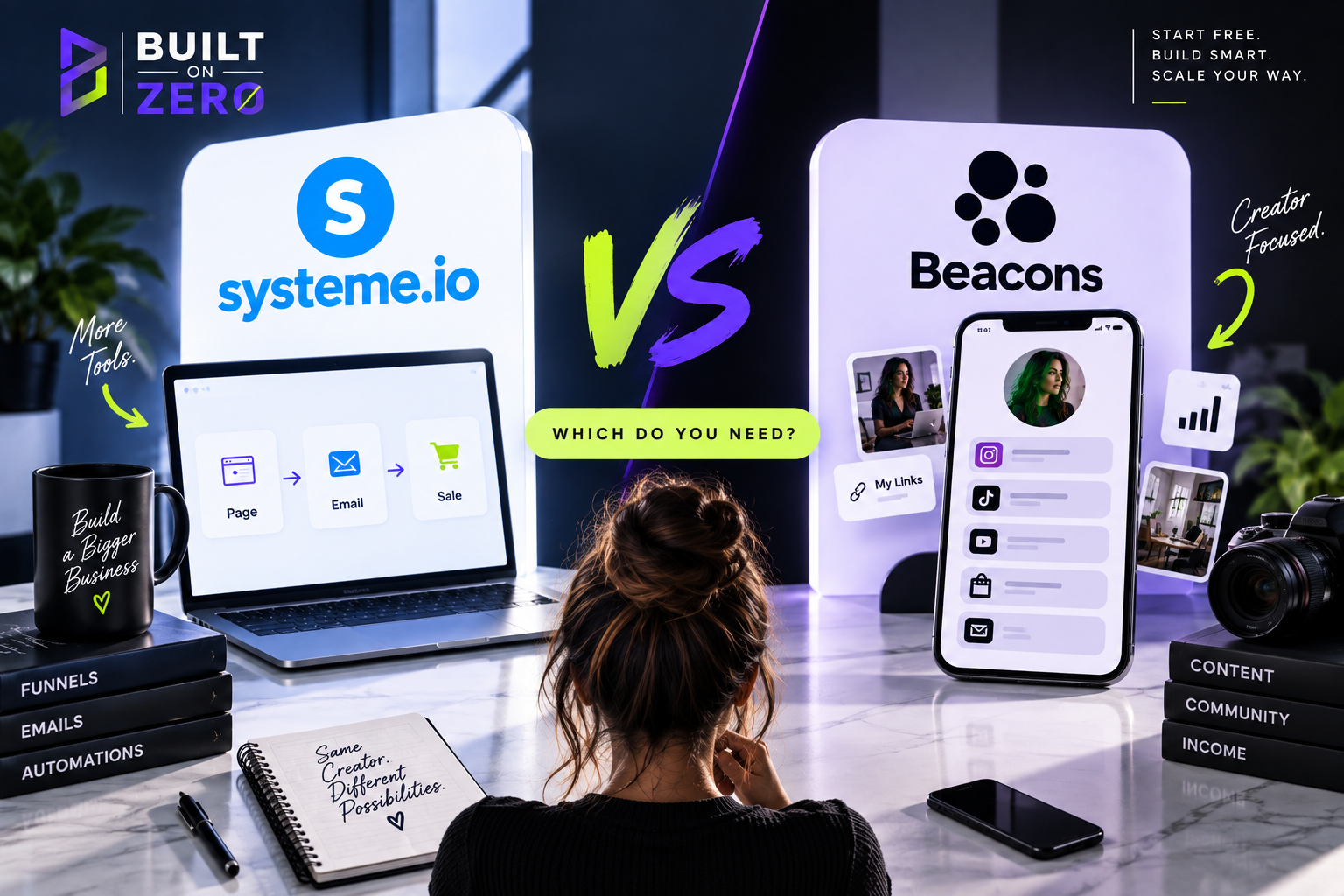
I nearly made Built on Zero harder than it needed to be because WordPress felt like the “proper” choice. I already knew how to use it, I had worked inside cPanel before, and there is something reassuring about building a website on a platform that has been around for years and can be extended into almost anything. Once I had created my first pages in Systeme.io, I started wondering whether I had taken a shortcut I would regret. Should I stop, build the real website on WordPress, keep Systeme.io for funnels and connect everything together properly before I went any further?
That question sounds sensible, but there was one awkward detail: Built on Zero still had no meaningful traffic and had not made its first $100. I was about to redesign the infrastructure of a business before I had proved that anybody wanted what the business was offering. This is exactly the kind of thing I am trying to stop doing with this project. I have enough business experience to know how easily preparation can disguise itself as progress, particularly when the preparation is something you are comfortable doing. I know WordPress. Building another WordPress site would have felt productive. It would not necessarily have moved me closer to revenue.
WordPress is genuinely powerful. The open-source WordPress software can be used and modified freely, and WordPress.org describes it as suitable for everything from simple blogs to business websites, portals and applications. Its real strength is flexibility. There are tens of thousands of plugins in the official directory, and themes and plugins can turn a basic installation into almost anything you need. If I were building a large publishing business, a complex membership site, a highly customised service website or something where I wanted very granular control over content, structure and functionality, WordPress would be difficult to dismiss. It is not the outdated dinosaur some funnel-builder comparisons make it sound like.
The catch is that WordPress is a content-management system, not a complete marketing business in a box. The software itself is free, but you need somewhere to host it. Then, depending on what you are building, you may add a page builder, form plugin, email platform, automation tool, security solution, backup system, SEO plugin, ecommerce system or any number of other extensions. Some are free and excellent. Some cost money. None of this is inherently bad; in fact, the ability to choose your own components is part of WordPress’s strength. The problem appears when a beginner does not actually want to become the architect of a technology stack. They want to put a page online, collect an email address and start selling something.
Systeme.io approaches the problem from the other direction. Instead of giving you a highly extensible website platform and letting you assemble the rest, it gives you a collection of business tools that are already designed to live together: funnels, email marketing, automation, courses, a blog, affiliate management and other marketing functions. Its current free plan includes 2,000 contacts, three funnels, a blog, a course and one custom domain with unlimited email sends. The appeal is not that its website-building capabilities are more sophisticated than everything WordPress can do. They are not. The appeal is that I can create the page, capture the contact and email that person without first deciding which three additional services will handle those jobs.
For Built on Zero, that difference matters. My immediate problem is not “How do I build the most expandable website architecture?” It is “How do I get somebody who discovers my content to take the next useful step?” If that person reads an article about starting affiliate marketing without money, I want to offer the $0 Business Stack. If they want it, I need to capture their email address. I need to deliver what I promised. I then need a sensible way to continue the conversation. Systeme.io keeps that chain short enough that I can focus on whether the content and offer work rather than whether the plugins are talking to each other.
There is also an uncomfortable truth about beginners and flexibility: sometimes too much choice is a burden. WordPress’s enormous ecosystem means there can be ten credible ways to solve the same problem. That is wonderful when you know what you want. It can be paralysing when you do not. Which theme? Which page builder? Which email service? Which form plugin? Which SEO plugin? Which caching plugin? Do these two plugins conflict? Why does the mobile layout look different after the update? You can solve all of those problems, but you should ask whether solving them is currently the best use of your time.
That does not mean I think everyone should abandon WordPress for Systeme.io. If organic search becomes the main growth engine for Built on Zero and the blog grows into hundreds of articles with more complex content requirements, I may decide WordPress gives me the publishing control I want. If I needed a very specific functionality available through a mature WordPress plugin, that could change the equation too. WordPress also gives you a level of ownership and portability that matters to many businesses. WordPress.org explicitly emphasises control over your content and data, and that is a legitimate advantage rather than a technical footnote.
So which should a beginner use? I think the answer depends less on which platform is “better” and more on what is stopping you from launching. If you need a flexible website that will become a substantial content or custom-functionality asset, and you are comfortable managing hosting and plugins, WordPress is a serious choice. If you are trying to get a small online business moving quickly and your first needs are landing pages, email collection, simple automation and selling, Systeme.io may remove more friction. The important thing is not to pay for or build complexity simply because successful businesses you admire eventually needed it.
This is where I would be careful with advice from creators who are already far ahead of you. Their businesses may have teams, established audiences, products that already sell and enough revenue to justify specialist software. Copying their current setup can be like buying the kitchen of a successful restaurant because you want to learn how to cook. Their infrastructure is the result of scale. It is not necessarily what created the first sale. Built on Zero is deliberately interested in the stage before all of that, when every rand and every hour still needs to earn its place.
If you are stuck between WordPress and Systeme.io today, I would run a very simple test. Write down the next thing your business needs to accomplish, not the twenty things you think it might need next year. If the answer is “publish a deep library of content with maximum control,” investigate WordPress seriously. If the answer is “I need a page where people can sign up, and I need to email them afterwards,” you can have that running in Systeme.io without paying for the platform.
There is also a cost nobody puts neatly into comparison tables: maintenance attention. A WordPress site gives you control, but control comes with responsibility. Themes, plugins, hosting, backups, security and updates are not necessarily difficult, particularly if you are experienced, but they are things somebody has to think about. For a normal business website that may be entirely worthwhile. For a one-person experiment trying to publish content and earn its first commission, every maintenance task competes with the work that actually attracts readers.
SEO complicates the decision because WordPress has an enormous ecosystem around search optimisation, and that is one of the reasons I still see it as a strong long-term publishing platform. Built on Zero is going to take Google seriously, so I am not dismissing that advantage. But Google does not rank a website because I installed WordPress. I still need original, useful content that answers real searches, internal links that make sense, pages that load properly and enough time for the site to build authority. Moving platforms will not rescue thin articles. The content strategy has to work whichever CMS sits underneath it.
My current decision is therefore deliberately reversible. I can use Systeme.io to prove the audience and monetisation model now. If the blog becomes large enough that WordPress’s publishing flexibility creates a meaningful advantage, I can make that decision with traffic data in front of me instead of fear. Beginners are often told to “build for scale,” but building for imaginary scale can be expensive. I would rather build for proof, then scale what has actually proved itself.
OPEN A FREE SYSTEME.IO ACCOUNT AND BUILD THE FIRST PAGE — CLICK HERE
That is an affiliate link, so I may earn a commission if you later purchase an eligible Systeme.io plan. You do not need to purchase anything for the experiment I am suggesting. Build the page. See how it feels. Then make the decision from experience rather than another ten comparison articles. I still like WordPress. I simply no longer think “more powerful” automatically means “more appropriate for the problem I have today.” That distinction has probably saved Built on Zero several unnecessary weeks of building things nobody had asked for.
A quick note before you go: Software pricing, features, free-plan limits and terms can change, sometimes without much notice. Everything in this article was accurate to the best of my knowledge when it was written or last updated, but please check the provider’s official website for the latest pricing, features and terms before making a decision or signing up. Built on Zero does its best to keep our guides current, but we can’t guarantee that every price or feature will remain unchanged after publication.