I had already broken my own rule before I’d properly started.
Built on Zero was supposed to cost zero. That wasn’t just a name I thought would look good on Instagram. It was the whole experiment. I wanted to find out whether I could take the skills I already had, use what was freely available online and build something that could make its first $100 without first spending $100 on subscriptions, courses and software. It sounded perfectly reasonable until I actually tried to build it.
Suddenly, I needed things. I needed somewhere for people to sign up. I needed email marketing. I needed somewhere to put the $0 Business Stack I was creating as my first free resource. Apparently, I needed a funnel, although at that point I was still trying to work out where a normal webpage stopped and a “funnel” began. Then there were automations, landing pages, email sequences, forms and a link-in-bio page. Every problem seemed to have its own piece of software, and almost every piece of software seemed to have the same irritating little catch: it was free until I needed the thing I had actually come there to use.
Then it was $19 a month. Or $29. Or $49. Or “start your 14-day free trial,” which is really just a more attractive way of asking for your credit card before your business has made enough money to buy you a coffee.
I remember sitting there looking at all of this and thinking, this is ridiculous. I was trying to make my first $100 online and somehow I was supposed to spend the first $100 assembling the machinery that might eventually help me make it. That was the exact opposite of what I was trying to prove with Built on Zero, so I started looking for another way.
That’s how I ended up opening a free Systeme.io account.
Now that I’ve actually used it to start building Built on Zero, I can answer the question I had when I first came across it: Is Systeme.io genuinely useful for someone starting with no budget, or is it another “free” platform that becomes useless the moment you refuse to enter your card details?
The short answer is that I’m still using it. The longer answer is why.
I wasn’t looking for a funnel builder. I was trying to solve one small problem.
I think this is where most software reviews lose normal people. They start with features. Email marketing. Sales funnels. Courses. Automations. Workflows. A/B testing. Check, check, check. Within three paragraphs you’re reading a product brochure when all you really wanted to know was, Can this thing solve the problem I have without costing me money?
My problem was much less impressive. I’d created a free resource called the $0 Business Stack, and I needed somewhere for a person to find it, enter an email address and receive it. That was the immediate job. But I also realised that if someone downloaded my resource and disappeared forever, I hadn’t really built much of a business. I needed to be able to contact that person again. If I created another useful guide, I wanted to tell them. If I published an article that could help them, I wanted to bring them back. If I discovered a tool that genuinely helped me build the business, I wanted to be able to recommend it.
In other words, I wasn’t simply looking for somewhere to host a PDF. I was beginning to build an audience I could actually reach again.
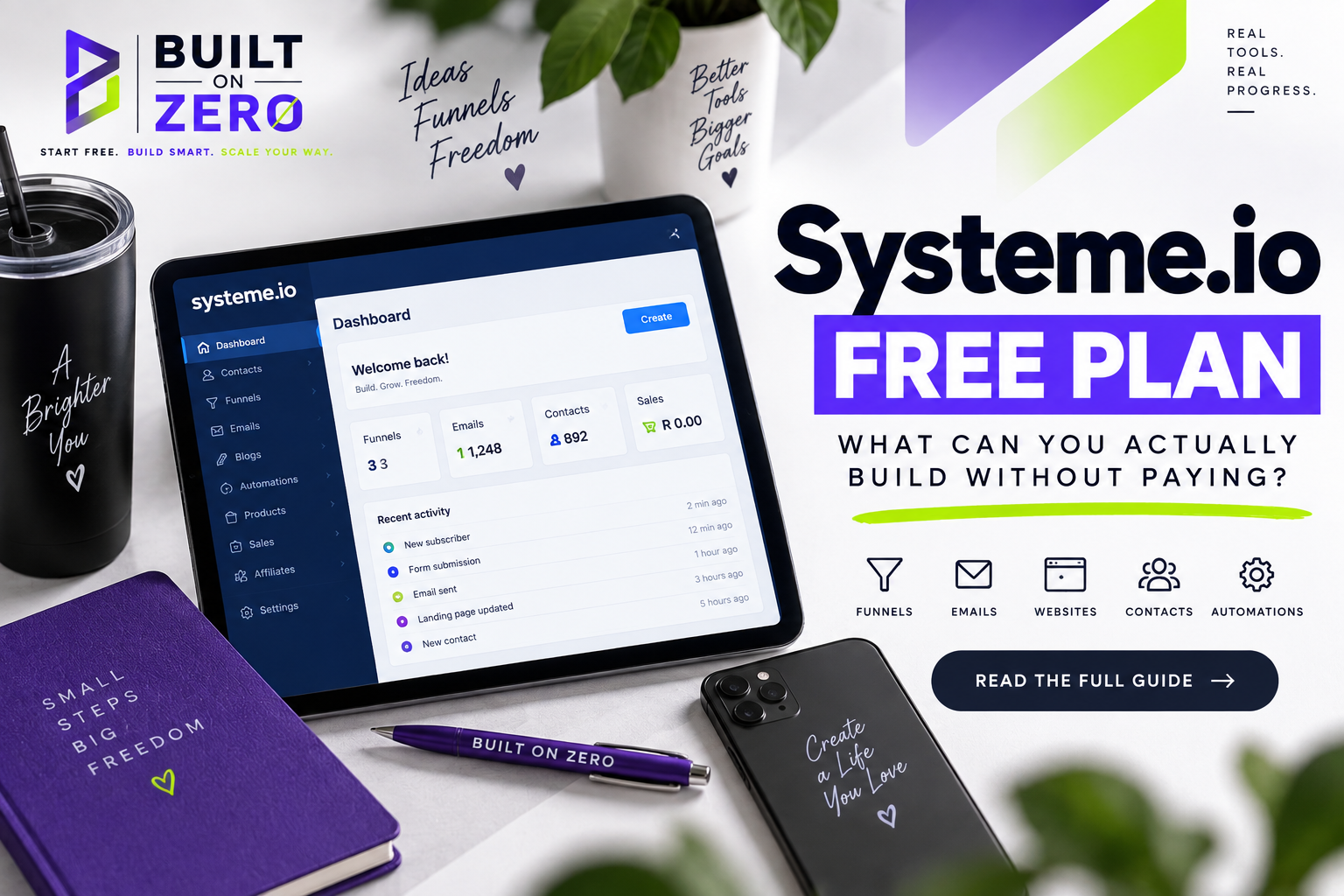
That’s when Systeme.io started making sense. Its current free plan gives you up to 2,000 contacts, three sales funnels, a blog, a course, one custom domain and unlimited email sends. More importantly for my experiment, the free plan doesn’t expire and Systeme.io doesn’t require a credit card to open it.
Two thousand contacts sounded almost comical when my email list contained precisely nobody, but that was actually what I liked about it. I didn’t need software for the imaginary business I might have three years from now. I needed something that could handle the embarrassingly small business I had today.
So I signed up.
If you’re currently doing what I did and have six different comparison articles open because you’re frightened of choosing the wrong platform, I would stop researching long enough to actually test one. You don’t have to decide whether Systeme.io will run your business forever. Open the free account, don’t buy anything, build something small and see whether you like using it.
TRY SYSTEME.IO FREE — CLICK HERE
That is my affiliate link. If you use it and eventually decide to buy an eligible Systeme.io product or plan, I may earn a commission. It doesn’t increase what you pay. Systeme.io currently pays affiliates a 60% lifetime commission on qualifying sales, so I want to be completely transparent about why that link is there.
I also don’t want you upgrading because I told you the platform is good. Use the free version first. That’s what I’m doing.
The first thing I built was extremely unexciting
There was no dramatic entrepreneur moment when I created my first funnel. I didn’t press Publish and wake up the next morning to $10,000 in Stripe notifications. I made a squeeze page. That’s it. It had one job: make the $0 Business Stack useful and interesting enough that somebody would be willing to leave an email address to get it.
Then I created a thank-you page.
Again, hardly revolutionary. But something changed once those two pages existed. Built on Zero wasn’t just an Instagram account, a domain and a collection of ideas in my head anymore. There was somewhere I could actually send a person, and when that person arrived, something could happen next.
I think this stage is much more important than people admit because it is unbelievably easy to spend weeks preparing to start an online business without actually starting one. You choose colours, change the colours, create a logo, change the logo, set up social accounts, rewrite the bio, watch fourteen videos about affiliate marketing, save thirty-seven Pinterest posts about passive income and spend an entire evening researching the best email platform. At the end of all that work, nobody can buy anything from you, nobody can join your email list and nobody can download anything. You’ve been extremely busy without creating a functioning business.
I know this because I can fall into exactly that trap.
Getting those first pages built mattered because there was finally a little piece of infrastructure behind the idea. Somebody could arrive, sign up and move to the next step. That was the first point at which Systeme.io became more useful to me than another collection of features on a pricing page. It got me from thinking about building a funnel to actually having one without forcing me to make a financial decision first.
Then I wondered whether I’d built everything in the wrong place
My next problem was completely predictable. I already know WordPress. I’ve worked with WordPress and cPanel before, so once the funnel existed I started wondering whether I should build Built on Zero “properly” on WordPress. Maybe Systeme.io should only handle the funnels. Maybe WordPress should be the real website. Maybe I needed both.
And there it was again: complexity creeping back in.
This is something I think beginners are particularly vulnerable to because there is always somebody online telling you that you need one more thing. You don’t just need a website; you need the right website. Then you need a theme, a page builder, plugins, an SEO tool, separate email software, a funnel builder and possibly another tool to make all those tools talk to each other. Pretty soon your zero-cost online business has its own IT department.
I eventually had to return to the question I should probably have asked at the beginning: What does Built on Zero actually need right now?
Not what might it need if it has 100,000 monthly visitors one day. Right now, I need to publish useful content, create landing pages, collect email addresses, send emails, recommend things I genuinely use and eventually sell something. Systeme.io can handle a surprising amount of that in one place.
That doesn’t mean I suddenly think WordPress is useless. I don’t. There are circumstances where I’d choose WordPress without hesitation, particularly for a large content-heavy site where I wanted much more control over the structure and functionality. We’ll get into that properly when I compare Systeme.io and WordPress because the answer isn’t as simple as “one is better.”
The lesson I took from it was different. I was trying to solve future problems before I’d solved today’s problem of having no traffic and no revenue. I think new online businesses waste a lot of time doing that.
Then I met DNS records
This is the part I want to include because otherwise this becomes one of those suspiciously perfect reviews where the writer signs up, clicks three buttons and announces that everything was “seamless.”
Everything was not seamless.
I owned builtonzero.com and wanted to connect it properly. Eventually I found myself staring at DNS records: CNAME, TXT, domain authentication, email authentication and things ending in `_domainkey`. I knew enough about domains to know I didn’t want to start deleting and replacing DNS records simply because a tutorial told me to. I had other services associated with the domain, and breaking something while trying to save money would have been a particularly stupid ending to the Built on Zero experiment.
So I contacted Afrihost and asked them to help me add the records correctly.
What had confused me initially was that connecting a custom domain to Systeme.io and authenticating that domain for email are separate jobs. The custom-domain setup uses DNS records to point the domain toward Systeme.io, while email authentication involves additional records used to establish that Systeme.io is authorised to send email from your domain. That distinction is documented in Systeme.io’s current support material, but when you’re staring at a DNS panel for the first time, it isn’t necessarily obvious why you’re being given several different sets of records.
The experience didn’t make me stop using Systeme.io. It did make me suspicious of reviews that tell beginners absolutely everything is easy. Some things are easy. Some things are easy once you understand what they mean. And some things are better handed to the person who manages your domain if you aren’t comfortable touching DNS settings.
That’s normal. You’re building something on the internet. Eventually the internet is going to make you learn something you had absolutely no intention of learning.
The part of Systeme.io I underestimated
Before using it, I assumed the big advantage was getting several tools in one account. That’s certainly useful, particularly when you’re trying not to pay for five different subscriptions, but I’ve realised there’s another benefit I value more: it reduces the number of decisions I have to make.
Every additional platform creates another decision and often another connection. Which email provider? Which landing-page builder? How do they connect? Does the free version integrate? Why isn’t the form adding the contact to the right list? Do I now need Zapier? What’s a webhook, and why am I suddenly watching a 22-minute video explaining one when all I wanted to do was send somebody a PDF?
Sometimes separate specialist tools are worth the effort because they’re substantially better at a particular job. I don’t believe “all in one” automatically means “best.” But when you haven’t earned your first $100 yet, I think complexity deserves much more suspicion than it gets.
I would rather have a system that’s good enough and running than spend three weeks constructing the world’s most sophisticated zero-revenue technology stack. That’s probably the strongest argument I can make for Systeme.io after actually using it. It has allowed me to keep moving. When you’re starting, that matters more than having every possible feature.
Would I pay for Systeme.io?
At the moment, no.
That may be an odd thing to write in an affiliate review, but the whole point of Built on Zero is to see how far I can get before spending money becomes necessary. Paying for Systeme.io while the free plan still covers what I need would defeat my own experiment.
I don’t think you should rush to pay for it either. If you’re starting with a small audience, use the free plan until you have an actual reason to move. Not a hypothetical reason based on what your business might become. An actual limit that is stopping you from doing something useful.
The free tier currently accommodates 2,000 contacts and includes unlimited email sends. If I somehow take Built on Zero from an empty email list to more than 2,000 contacts and my next problem is that I’ve outgrown my free marketing platform, I will accept that problem with enormous enthusiasm.
Until then, I’m keeping the money.
So, would I recommend Systeme.io?
Yes, but to a particular person.
I’d recommend it to someone who has an idea and very little budget and is trying to turn that idea into something functional. Maybe you’re starting affiliate marketing. Maybe you want to sell a small digital product. Maybe you’ve been telling yourself you’re going to build an email list. Maybe you’ve spent six months saying you’re “starting an online business” but every time you investigate what that actually involves, the amount of software makes the whole thing feel more complicated and expensive than you expected.
That’s who I think should try it.
I wouldn’t recommend Systeme.io because I believe it is magically better than every specialised platform on the internet. I wouldn’t recommend it because using a funnel builder will suddenly make you money. It won’t. I still have to create content people care about, get traffic, earn people’s trust, grow an email list and eventually convince somebody that something I’m recommending is worth paying for.
Systeme.io hasn’t solved the hard part of Built on Zero. It has removed several things that were getting in the way of me attempting the hard part.
I now have somewhere to send people. I can collect their email addresses, email them, build funnels, use my domain and create the basic infrastructure I need to find out whether I can turn attention into income. Right now, I can do those things without another monthly payment.
That’s enough for me to keep using it.
Before you open another comparison article
I know how easy it is to convince yourself that endless research is responsible. I do it too. You read a Systeme.io review, then Systeme.io versus ClickFunnels, then Systeme.io versus Kit, then Systeme.io versus WordPress. Someone in a Reddit thread mentions another platform you’ve never heard of, so naturally you need to investigate that one as well. Three hours later, you’re incredibly well-informed and have built absolutely nothing.
There is a point where research stops protecting you from making a bad decision and starts protecting you from having to make any decision at all.
If you’re already at that point, I wouldn’t ask you to commit to Systeme.io. I wouldn’t even ask you to buy it. I’d ask you to do something much smaller: open the free account and build one page.
Not your business. Not a twelve-step funnel. One page.
If you hate the editor, leave. If you find the whole platform confusing, leave. If you build the page and think, Okay, I could actually work with this, then keep going. You haven’t had to gamble a subscription fee to find out.
START YOUR FREE SYSTEME.IO ACCOUNT – CLICK HERE
That is why I think the free plan is ultimately Systeme.io’s most persuasive feature. You don’t really need me to convince you that you’ll like the software. You can find out for yourself without paying for the privilege.
I’m going to keep documenting what happens as I build Built on Zero, including the things that don’t work. Next, I’ll dig into exactly what the Systeme.io free plan lets you build before you hit a paywall, because “free” is one of those words I have learned to investigate very carefully.
If you’re building from zero too, you may as well learn from the mistakes I make first.